
Here are complete sample answers for Cambridge IELTS 15 Test 1 Writing.
IELTS Writing Task 1
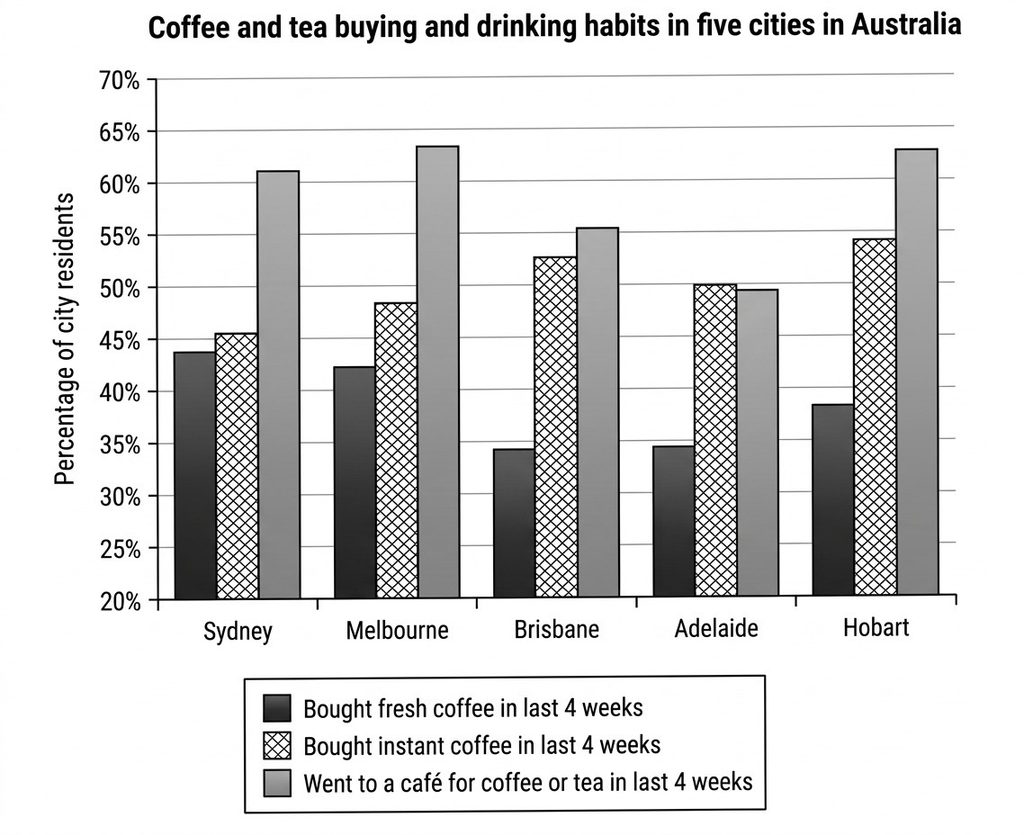
The chart below shows the results of a survey about people’s coffee and tea buying and drinking habits in five Australian cities.
Summarize the information by selecting and reporting the main features, and make comparisons where relevant.
(You should spend about 20 minutes on this task. Write at least 150 words)
Note: These IELTS Writing responses are subjective examples and do not guarantee the indicated band scores.
The bar chart show about coffee and tea habits in five cities of Australia. It shows people who buy fresh coffee, instant coffee and go to café in last four weeks.
Overall, many people go to café in all cities. Fresh coffee is not very popular. People in Melbourne and Hobart go more café than other cities.
In Sydney, 61% people go to café and 46% buy instant coffee. About 44% people buy fresh coffee. In Melbourne, café visitors are 63% and instant coffee buyers are 48%. In Brisbane, 53% people buy instant coffee and 56% go to café.
In Adelaide, about 50% people buy instant coffee and 49% go to café. In Hobart, 63% people visit café. About 55% buy instant coffee and 39% buy fresh coffee.
(128 words)
The bar chart shows the percentage of people in five Australian cities who buy fresh coffee, instant coffee or visit cafes for coffee and tea during the last four weeks.
Overall, visiting cafes was the most populer activity in most cities. However, fresh coffee was the least popular choice in all five cities. Adelaide was the only city where instant coffee was more popular than visiting cafes.
In Sydney, about 61% of people visited cafes, while 46% bought instant coffee and 44% purchased fresh coffee. In Melbourne, the figure for cafe visitors was around 63%, which was the highest among the five cities. About 48% people bought instant coffee, compared to 42% who purchased fresh coffee.
In Brisbane, 56% of people visited cafes and 53% bought instant coffee. In Adelaide, around 50% purchased instant coffee, while 49% visited cafes. Finally, Hobart had about 63% cafe visitors and 55% instant coffee buyers. Fresh coffee was purchased by only 39% of people.
(160 words)
The bar chart compares the percentages of people in five Australian cities who purchased fresh coffee, instant coffee or visited cafés for coffee or tea over a period of four weeks.
Overall, visiting cafés was the most popular activity in four out of five cities. Fresh coffee was the least popular choice in all five locations. Adelaide was the only city where instant coffee purchases were slightly higher than café visits.
In Sydney, approximately 61% of people visited cafés, compared with 46% who bought instant coffee and 44% who purchased fresh coffee. Melbourne recorded the highest proportion of café visitors, at around 63%. The figures for instant and fresh coffee were 48% and 42%, respectively.
In Brisbane, 56% of residents visited cafés, while 53% purchased instant coffee. In Adelaide, instant coffee buyers accounted for 50%, slightly higher than café visitors at 49%. Hobart also recorded a high percentage of café visitors, at 63%, while 55% bought instant coffee and 39% purchased fresh coffee.
(163 words)
The bar chart illustrates the proportions of residents in five Australian cities who purchased fresh coffee or instant coffee, or visited a café for coffee or tea during the previous four weeks.
Overall, visiting cafés was the most popular activity in four cities, whereas purchasing fresh coffee was consistently the least common. Adelaide was the only exception, where instant coffee purchases slightly exceeded café visits.
Melbourne and Hobart recorded the highest percentages of café visitors, at approximately 63% each, followed closely by Sydney at 61%. The figure was lower in Brisbane, at 56%, while Adelaide had the smallest proportion, at just under 50%.
Regarding instant coffee, Hobart had the highest percentage of buyers, at around 55%, followed by Brisbane at 53%. Adelaide, Melbourne and Sydney recorded approximately 50%, 48% and 46%, respectively. Fresh coffee purchases were comparatively less common, ranging from about 34% in Brisbane to 44% in Sydney. Melbourne, Adelaide and Hobart stood at roughly 42%, 35% and 39%, respectively.
(161 words)
The bar chart compares the proportions of residents in five Australian cities who purchased fresh coffee or instant coffee, or visited a café for coffee or tea over the preceding four weeks.
Overall, café visits dominated in four of the five cities, with Melbourne and Hobart recording the highest proportions. Fresh coffee purchases, by contrast, were consistently the least common activity. Adelaide was the sole exception to the general preference for café visits, as instant coffee purchases marginally outnumbered them.
Café attendance peaked at approximately 63% in both Melbourne and Hobart, followed by Sydney at 61%. The figures for Brisbane and Adelaide were considerably lower, at 56% and just under 50%, respectively.
Hobart had the highest proportion of instant coffee buyers (55%), narrowly ahead of Brisbane (53%). The corresponding figures for Adelaide, Melbourne and Sydney were approximately 50%, 48% and 46%. Fresh coffee attracted fewer buyers, with Sydney leading at 44%, while Brisbane recorded the lowest figure, at around 34%.
(160 words)
IELTS Writing Task 2
In some countries, owning a home rather than renting one is very important for people.
Why might this be the case? Do you think this is a positive or negative situation?
(You should spend about 40 minutes on this task. Write at least 250 words.)
Note: These IELTS Writing responses are subjective examples and do not guarantee the indicated band scores.
In my country people like own house very much. Because rent house is not good for people. Every month people need give money for house. It is very difficult for poor people. Also house owner sometimes make problem and people need change house. Some people cannot stay in one house for long time because owner do not want them. For this reason people want to buy their own house.
I think own house is good for everyone. When people have own house they can live happy and no need pay rent. They can do anything in their house. They can make their house beautiful and stay with family. Nobody can tell them to leave the house. But buying house is very much expensive. Many people have no enough money for buy a house. So they cannot do it. Some people take loan from bank but it is also difficult to pay every month.
In my opinion, own house is good thing. People want house for their family and children. It is also important for future. When parents have a house, their children can live there and they do not need to find another house. I think government should help people to get house because house is very important in life. Everyone need a place to live peacefully.
(217 words)
In many countries, people like to have their own house instead of living in a rent house. There are some reasons behind this thinking. In my opinion, it is a positive situation because people can live more freely in their own house.
First of all, people do not like to pay rent every month. It is sometimes very difficult for people who have low income. Also, house owners can increase the rent at any time. Sometimes they also tell the tenants to leave the house. For this reason, people want to buy their own house so that they can live without these problems.
Another reason is that people think buying a house is good for future. The price of land and house can increase after some years. So people think they can get more money if they sell it later. They can also give the house to their children.
I think it is a positive thing because everyone want a safe place to live. People can stay with their family and do not need to worry about house rent. But buying a house is not easy because it cost a lot of money. Many people cannot afford it and they need to take loan from bank.
In conclusion, owning a house is important for people because it gives them safety and freedom. I think it is a good situation, but everyone cannot buy a house. People should think wisely before taking a decision.
(243 words)
In some countries, owning a house is considered more important than living in a rented one. There are several reasons why people have this opinion. I believe this is generally a positive situation, although it can sometimes create financial difficulties for many families.
One of the main reasons is that people want to avoid paying rent every month. For many families, rent takes a large part of their monthly income. Moreover, landlords can increase the rent or ask tenants to leave the property. This makes people feel insecure about their living situation. Having their own house can help them avoid these problems and live more comfortably for many years.
Another reason is that people consider a house a valuable investment. Property prices often increase over time, so people believe that buying a house can be financially beneficial in the future. They can also leave the property for their children, which gives them a sense of responsibility towards their family.
I think this is a positive situation because having a permanent home provides security and independence. People can decorate their houses and make changes according to their needs. However, buying a house requires a large amount of money. Some people take huge bank loans and spend many years paying them back. This can put them under financial pressure and affect their daily lives.
In conclusion, owning a house is important because it provides security and can be a good investment. However, people should carefully consider their financial situation before making such a big decision.
(253 words)
In many countries, owning a home is considered more desirable than renting one. This preference is largely driven by the desire for financial security, personal stability and independence. I believe this is generally a positive situation, although an excessive focus on property ownership can have some disadvantages.
One major reason people prefer owning a home is the sense of security it provides. Unlike tenants, homeowners do not have to worry about landlords increasing the rent or asking them to leave unexpectedly. This is particularly important for families with children, who often prefer a stable living environment. Furthermore, owning a property allows people to make changes to their homes without seeking permission from a landlord.
Financial considerations are another important factor. Property is widely regarded as a long-term investment because its value may appreciate over time. Rather than spending a significant portion of their income on rent, people can gradually build wealth through home ownership. They can also pass their property on to their children, providing the next generation with some financial security.
I consider this preference largely positive because owning a home offers both emotional and financial benefits. However, some people become so determined to purchase property that they take out enormous loans and put themselves under considerable financial pressure. In addition, prioritising home ownership may discourage people from relocating for better employment opportunities.
In conclusion, owning a home offers security, independence and potential financial benefits. Nevertheless, people should consider their financial circumstances carefully rather than treating property ownership as an essential measure of success.
(255 words)
In many countries, owning a home is regarded as a more desirable option than renting. This preference stems from a combination of financial, social and psychological factors. I believe it is largely positive, provided that people do not sacrifice their financial well-being in pursuit of property ownership.
The strongest motivation is arguably the sense of permanence that owning a home provides. Tenants are often exposed to rent increases, uncertain rental agreements and the possibility of having to relocate at short notice. Homeowners, by contrast, enjoy greater control over their living arrangements, which is particularly valuable for families seeking a stable environment in which to raise children. Property ownership also gives people the freedom to modify their homes according to their preferences.
Another significant consideration is the perception of property as a reliable means of accumulating wealth. Although house prices do not always rise, property has historically been viewed as a long-term investment that can provide financial security. Furthermore, homeowners can pass their assets on to their children, potentially giving future generations a considerable economic advantage.
I consider this trend positive because home ownership can provide both stability and a valuable financial asset. Nevertheless, the growing obsession with owning property can be counterproductive. Some individuals commit themselves to decades of mortgage repayments, leaving little room for other financial priorities. Others may miss valuable career opportunities because they are reluctant to move away from their property.
In conclusion, the desire to own a home is understandable and generally beneficial. However, it should be a personal financial choice rather than a social expectation or a universal definition of success.
(266 words)