
Subject Code: 107
Time: 3 Hours
Full Marks: 100
Part A – Reading Test
Marks: 60
1. Read the passage and answer the questions A and B:
At daylight, I was half-awakened by the sound of chopping. Again it was so even in texture that I went back to sleep. When I left my bed in the cool morning, the boy had come and gone, and a stack of kindling was neat against the cabin wall. He came after school in the afternoon and worked until time to return to the orphanage. His name was Jerry. He had been at the orphanage since he was four. I could picture him at four with same grave gray-blue eyes and the same independence? No, the word that comes to me is ‘integrity’………… It is bedded on courage, but it is more than brave. It is honest, but it is more than honesty. The ax handle broke one day. Jerry said the woodshop at the orphanage would repair it. I brought money to pay for the job and he refused it.
“I’ll pay for it,” he said. “I broke it. I brought the ax down careless.”
“But no one hits accurately every time,” I told him.
“The fault was in the wood of the handle. I’ll see the man from whom I bought it.”
It was only then that he would take the money. He was standing back of his own carelessness. He was a free-will agent and he chose to do careful work, and if he failed, he took the responsibility without subterfuge.
And he did for me the unnecessary thing, the gracious thing, that we find done only by the great of heart. Things no training can teach, for they are done on the instant, with no predicated experience. He found a cubbyhole beside the fireplace that I had not noticed. There, of his own accord, he put kindling and ‘medium’ wood, so that I might have dry fire materials ready in case of sudden wet weather. A stone was loose in the rough walk to the cabin. He dug a deeper hole and steadied it, although he came himself by a shortcut over the bank. I found that when I tried to return his thoughtfulness with such things as candy and apples, he was wordless. ‘Thank you’ was perhaps an expression for which he had had no use, for his courtesy was instinctive. He only looked at the gift and at me, and a curtain lifted, so that I saw deep into the clear well of his eyes, and gratitude was there, and affection, soft over the firm granite of his character.
A. Choose the correct answer from the alternatives: 0.5×10=5
(a) Jerry’s courtesy was —.
(i) Artificial
(ii) Acquired
(iii) Inborn
(iv) Taught
(b) What does the phrase ‘of his own accord’ indicate?
(i) Half-heartedly
(ii) Reluctantly
(iii) Neutrally
(iv) Willingly
(c) What does the word ‘subterfuge’ in the passage refer to?
(i) Deception
(ii) Honesty
(iii) Openness
(iv) Candidness
(d) Jerry wanted to get the ax handle —.
(i) Repair
(ii) Fixed
(iii) Made
(iv) Reshaped
(e) Jerry chose to do careful work because of his —.
(i) Intelligence
(ii) Courage
(iii) Meanness
(iv) Responsibility
(f) The author was half-awakened by the —.
(i) Sound of barking
(ii) Sound of footsteps
(iii) Sound of cutting wood
(iv) Sound of rain
(g) ‘Cubbyhole’ means —.
(i) A small enclosed space
(ii) A noisy place
(iii) A deep hole
(iv) A snake hole
(h) ‘I saw deep into the clear well of his eyes’—What did the writer see?
(i) Steadiness
(ii) Gratefulness
(iii) Farsightedness
(iv) Freedom
(i) What does the word ‘integrity’ in the passage mean?
(i) Intuition
(ii) Simplicity
(iii) Uprightness
(iv) Incompleteness
(j) Jerry had been at the orphanage —.
(i) For four years
(ii) For eight years
(iii) For twelve years
(iv) For six years
Answers: (a) (iii) Inborn (b) (iv) Willingly (c) (i) Deception (d) (ii) Fixed (e) (iv) Responsibility (f) (iii) Sound of cutting wood (g) (i) A small enclosed space (h) (ii) Gratefulness (i) (iii) Uprightness (j) (ii) for eight years.
ব্যাখ্যা:
(a) Jerry’s courtesy was instinctive, অর্থাৎ স্বাভাবিক বা জন্মগত। তাই Inborn সঠিক উত্তর।
(b) ‘Of his own accord’ অর্থ স্বেচ্ছায় বা নিজের ইচ্ছায়। তাই Willingly সঠিক।
(c) Subterfuge অর্থ ছলনা, প্রতারণা বা সত্য গোপন করার কৌশল। Deception এর সমার্থক।
(d) ‘Get something fixed’ একটি causative structure, যার অর্থ কোনো কিছু মেরামত করিয়ে নেওয়া। তাই Fixed সঠিক।
(e) Jerry নিজের কাজের ভুলের দায়িত্ব নিজেই গ্রহণ করেছিল। এটি তার responsibility বা দায়িত্ববোধের পরিচয়।
(f) Passage-এর শুরুতেই বলা হয়েছে, লেখিকা কাঠ কাটার শব্দে অর্ধজাগ্রত হয়েছিলেন। তাই Sound of cutting wood সঠিক।
(g) Cubbyhole অর্থ ছোট, আবদ্ধ বা সংকীর্ণ জায়গা। তাই A small enclosed space সঠিক।
(h) লেখিকা Jerry-এর চোখে gratitude বা কৃতজ্ঞতা দেখতে পেয়েছিলেন। Gratefulness অর্থ কৃতজ্ঞতা।
(i) Integrity অর্থ নৈতিক সততা, নীতিবোধ ও চারিত্রিক দৃঢ়তা। Uprightness এর সবচেয়ে কাছাকাছি অর্থ।
(j) “A Mother in Mannville” – গল্পে লেখিকার বর্ণনা অনুযায়ী, Jerry-এর বয়স বারো বছর। সে চার বছর বয়স থেকে অনাথ আশ্রমে বসবাস করছে। সুতরাং, সে সেখানে আট বছর ধরে (১২ − ৪ = ৮) রয়েছে।
B. Answer the following questions: 2×5=10
(a) What unnecessary things did Jerry do for the authoress?
(b) How would Jerry usually react after getting gifts from the authoress?
(c) Why did Jerry refuse to take money from the authoress to repair the ax handle?
(d) Why was the authoress impressed with Jerry?
(e) Do you like the personality of Jerry? Why?
Answers:
(a) Jerry did several unnecessary but thoughtful things for the authoress. He arranged kindling and medium wood beside the fireplace so that she could easily use them during wet weather. He also repaired a loose stone in the rough path to her cabin to make it safer.
(b) Jerry usually remained wordless after receiving gifts from the authoress. He simply looked at the gifts and at her. However, his eyes expressed gratitude and affection.
(c) Jerry refused to take money because he believed that he was responsible for breaking the ax handle. He wanted to pay for its repair himself instead of making someone else bear the cost of his carelessness.
(d) The authoress was impressed with Jerry because of his honesty, integrity, responsibility and natural courtesy. He always took responsibility for his mistakes and did thoughtful things for her without expecting anything in return.
(e) Yes, I like Jerry’s personality very much because he is honest, responsible, thoughtful and courteous. He takes responsibility for his mistakes and helps others without expecting rewards. His character teaches us the importance of integrity and kindness.
2. Based on your reading of the passage, make short notes in each of the boxes in the flow-chart showing the functions of education. (Number 1 has been done for you). 10 Marks
Education not only enriches us with knowledge, abilities and skills, it also teaches us values. Values can be individual, interpersonal, organizational or societal. Thus, students receiving good education develop self-respect but also learn to respect others; they know the importance of honesty and learn to trust others; they develop compassion and fellow feeling and become aware of the need to protect the environment. If students combine the values they learn at home with those that the school gives them, they will not deviate from the right path unless they fall into bad company, The famous French writer Victor Hugo once said, “He who opens a school door, closes a prison.”
Flow Chart:
- Enriches us with knowledge → 2. → 3. → 4. → 5. → 6.
Answer:
1. Enriches us with knowledge → 2. Developing self-respect → 3. Learning to respect others → 4. Learning honesty and trust → 5. Developing compassion and fellow feeling → 6. Becoming aware of the need to protect the environment
3. Write a summary of the following text: 10 Marks
We spend money for different reasons. We buy foods, clothes or everyday essentials, pay for different services, entertain people, travel to places, help others in need or invest in business and thus spend money everyday. In fact, spending is a part of our life. Spending may make us happy or unhappy depending on how and why we spend. When we spend money on things that we need and within our limit, it is good. When it becomes a compulsive behaviour, it makes life stressful. Unnecessary spending or spending beyond one’s means has some bad effects. For one thing, it may lead to financial ruin or debt, and for another, it may create unhappiness within families. People who overspend are never satisfied with what they have. They always rush for brands, fashion items, designer clothes etc. Over a period of time it becomes an addiction which may eventually create psychological problems.
Summary:
Spending money is an essential part of our daily life, but it should be controlled. Spending within one’s means brings satisfaction, whereas unnecessary and excessive spending causes stress, debt and family unhappiness. People who overspend often remain dissatisfied and become addicted to expensive brands and fashionable items, which may eventually lead to psychological problems.
(54 words)
4. Read the following text and fill in the blanks with suitable words from the box. There are more words than necessary. Make any grammatical change if necessary: 0.5×10=5
scarce | educate | value | go | bring | study | waste | married | decide | work | be | that | who | worry
Rokeya is a Bangladeshi girl (a) __________ is about to finish school but she has no hopes of (b) __________ on to college. Like millions of other parents, Rokeya’s parents think that educating a daughter is a (c) __________ of time and money. They have (d) __________ that they will now marry her off and use their (e) __________ resources for their son’s education. Rokeya used to (f) __________ about lessons and tests, but now she worries more about getting (g) __________ and having children. She used to dream about being a teacher, but now faces a life of household chores and (h) __________ up children. She used to be happy being a girl but now wishes she (i) __________ a boy. If she were a boy, she would be able to (j) __________ in college and university.
Answers: (a) who (b) going (c) waste (d) decided (e) scarce (f) worry (g) married (h) bringing (i) were (j) study
ব্যাখ্যা:
(a) Who — মানুষের পরিচয় বা সম্পর্ক বোঝাতে relative pronoun হিসেবে ব্যবহৃত হয়েছে।
(b) Going — ‘Hope of’ এর পরে gerund বসে। এখানে ‘going on to college’ অর্থ কলেজে পড়তে যাওয়া।
(c) Waste — ‘A waste of time and money’ একটি প্রচলিত expression, যার অর্থ সময় ও অর্থের অপচয়।
(d) Decided — ‘Have decided’ present perfect tense-এর structure। তাই decide-এর past participle বসেছে।
(e) Scarce — Scarce resources অর্থ সীমিত বা অপ্রতুল সম্পদ।
(f) Worry — ‘Used to’ এর পরে verb-এর base form বসে। Worry about অর্থ কোনো বিষয় নিয়ে চিন্তা করা।
(g) Married — ‘Get married’ অর্থ বিয়ে করা।
(h) Bringing — ‘Bring up children’ অর্থ সন্তানদের লালন-পালন করা। এখানে parallel structure অনুযায়ী bringing বসেছে।
(i) Were — Wish-এর পরে অবাস্তব বর্তমান পরিস্থিতি বোঝাতে were ব্যবহৃত হয়েছে।
(j) Study — ‘Be able to’ এর পরে verb-এর base form বসে। তাই study সঠিক।
5. Fill in the blanks with an appropriate word in each gap: 1×10=10
The world is producing millions of tons of domestic rubbish and (a) __________ industrial waste each year. It is becoming very difficult to find (b) __________ locations to (c) __________ rid of all these refuse. The dumping of (d) __________ kinds of waste is seriously (e) __________ the environment. We know that air is a/an (f) __________ element of our environment. But the air is polluted by (g) __________. Water, another vital element of the environment, is polluted by different kinds of waste and filth. If we want to live a (h) __________ life, we should prevent the pollution of the environment. Total prevention may be (i) __________ but we can certainly reduce pollution by raising (j) __________ among people.
Answers: (a) industrial (b) suitable (c) get (d) different (e) polluting (f) essential (g) smoke (h) healthy (i) impossible (j) awareness
ব্যাখ্যা:
(a) Industrial — Industrial waste অর্থ শিল্পবর্জ্য। Domestic rubbish-এর পাশাপাশি শিল্পবর্জ্যের কথাও বলা হয়েছে।
(b) Suitable — Suitable locations অর্থ উপযুক্ত স্থান।
(c) Get — ‘Get rid of’ একটি phrasal verb, যার অর্থ কোনো কিছু থেকে মুক্ত হওয়া বা তা সরিয়ে ফেলা।
(d) Different — Different kinds of waste অর্থ বিভিন্ন ধরনের বর্জ্য।
(e) Polluting — ‘Is seriously polluting’ present continuous tense-এর structure। এখানে পরিবেশ দূষিত করার কাজ বোঝানো হয়েছে।
(f) Essential — Essential অর্থ অপরিহার্য। বায়ু পরিবেশের একটি অপরিহার্য উপাদান।
(g) Smoke — Smoke অর্থ ধোঁয়া। ধোঁয়ার মাধ্যমে বায়ু দূষিত হয়।
(h) Healthy — Healthy life অর্থ সুস্থ জীবন। সুস্থভাবে বেঁচে থাকার জন্য পরিবেশ দূষণ প্রতিরোধ করা প্রয়োজন।
(i) Impossible — Impossible অর্থ অসম্ভব। সম্পূর্ণ দূষণ প্রতিরোধ করা কঠিন হতে পারে।
(j) Awareness — Awareness অর্থ সচেতনতা। মানুষের মধ্যে সচেতনতা বাড়ালে দূষণ কমানো যায়।
6. Rearrange the following sentences to make a coherent order: 1×10=10
(a) As Saadi was dressed in his usual inexpensive attire, the courtier didn’t recognize him.
(b) On his way back home from the emperor’s palace, Saadi deliberately stopped at the same courtier’s house.
(c) During the meal, however, the guest began to put the delicacies into the folds of his fine clothes.
(d) Sheikh Saadi, a renowned Persian poet, was travelling to the emperor’s palace.
(e) Saadi said that his clothes, in fact, deserved the food, reminding the host that last time he was shown poor hospitality because of his ordinary clothes.
(f) Seeing the expensive clothes of the guest, the courtier and his men were extremely hospitable, offering him a spread of fine dishes.
(g) Surprised, the courtier asked, “Why are you feeding your clothes, my honorable guest?”
(h) Night fell on the way, and the poet took shelter in a courtier’s house.
(i) This time, however, he was wearing the luxurious clothes given to him by the emperor.
(j) So, he treated the great man with indifference, offering him only a small meal and poor accommodation.
Answers: (d) → (h) → (a) → (j) → (b) → (i) → (f) → (c) → (g) → (e)
The Story of Saadi and His Clothes
Sheikh Saadi, a renowned Persian poet, was travelling to the emperor’s palace. Night fell on the way, and the poet took shelter in a courtier’s house. As Saadi was dressed in his usual inexpensive attire, the courtier didn’t recognize him. So, he treated the great man with indifference, offering him only a small meal and poor accommodation. On his way back home from the emperor’s palace, Saadi deliberately stopped at the same courtier’s house. This time, however, he was wearing the luxurious clothes given to him by the emperor. Seeing the expensive clothes of the guest, the courtier and his men were extremely hospitable, offering him a spread of fine dishes. During the meal, however, the guest began to put the delicacies into the folds of his fine clothes. Surprised, the courtier asked, “Why are you feeding your clothes, my honorable guest?” Saadi said that his clothes, in fact, deserved the food, reminding the host that last time he was shown poor hospitality because of his ordinary clothes.
Part B – Guided Writing
Marks: 40
7. The graph shows the percentage of different types of books preserved in a college library. Analyze the graph in about 150 words. 10 Marks
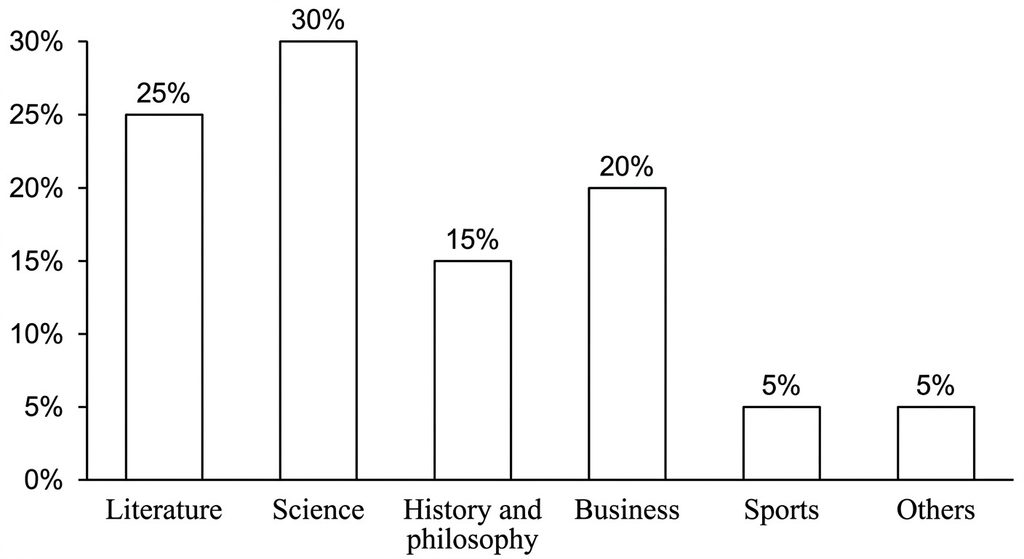
Percentage of Different Types of Books Preserved in a College Library
The bar graph illustrates the percentage of different types of books preserved in a college library. It shows that science books occupy the largest share, accounting for 30% of the total collection. Literature books hold the second position with 25%. Business books constitute 20% of the collection, while history and philosophy books account for 15%. On the other hand, sports books and other books represent only 5% each. Together, science and literature books make up 55% of the entire collection, indicating their importance in the library. Business books also have a considerable share, whereas sports and other books are comparatively limited. The graph clearly shows that the library gives greater importance to science and literature, while relatively fewer books are preserved in sports and miscellaneous categories. Overall, science books dominate the collection, and sports and other books occupy the smallest shares.
(152 words)
8. The following is the beginning of a story. Add around 150 words of your own to complete the story: 7 Marks
It was a foggy winter morning. Dr. Rabbi was driving home from hospital after his exhausting overnight shift. Driving was difficult because of the haze. Suddenly, he felt he had driven past somebody sitting by the road. He stopped the car and backed up to see who it was. It was an elderly man, dressed in thin, ragged clothes…………
A Doctor’s Kindness
It was a foggy winter morning. Dr. Rabbi was driving home from hospital after his exhausting overnight shift. Driving was difficult because of the haze. Suddenly, he felt he had driven past somebody sitting by the road. He stopped the car and backed up to see who it was. It was an elderly man, dressed in thin, ragged clothes. (59 words)
Dr. Rabbi got out of the car and approached the man. He was shivering with cold and looked very weak. The doctor asked him what had happened. The old man replied that he had suddenly fallen ill and could not walk any further. Dr. Rabbi immediately helped him into his car and took him to a nearby hospital. He arranged for his treatment and bought him some warm clothes and food.
After receiving treatment, the old man felt much better. He thanked Dr. Rabbi with tears in his eyes. The doctor smiled and told him not to worry. He then returned home, feeling tired but happy. He realized that helping helpless people was one of the greatest duties of a human being.
Total: 184 words. The question asks students to add around 150 words to the given passage.
Recommended: A total of 180–190 words is a practical range for the 7-mark allocation.
9. Imagine you are Lisa/Latif. You have a Facebook friend in Australia. Recently, she/he has shown interest in visiting Bangladesh. Now write a letter to him/her to give him a brief account of the sights and sounds of Bangladesh. 5 Marks
November 3, 2026
Dear Alex,
I am glad to know that you want to visit Bangladesh. It is a beautiful country with green fields, rivers, hills and villages. You can visit Cox’s Bazar, the longest natural sea beach, the Sundarbans, the tea gardens of Sylhet and the hills of Bandarban. You will also enjoy our traditional foods, colourful markets, boat rides and the lively sounds of village life. The people here are friendly and hospitable.
I hope you will visit Bangladesh soon. I would love to show you around.
Yours ever,
Latif
(92 words)