
Here are complete sample answers for Cambridge IELTS 15 Test 2 Writing.
IELTS Writing Task 1
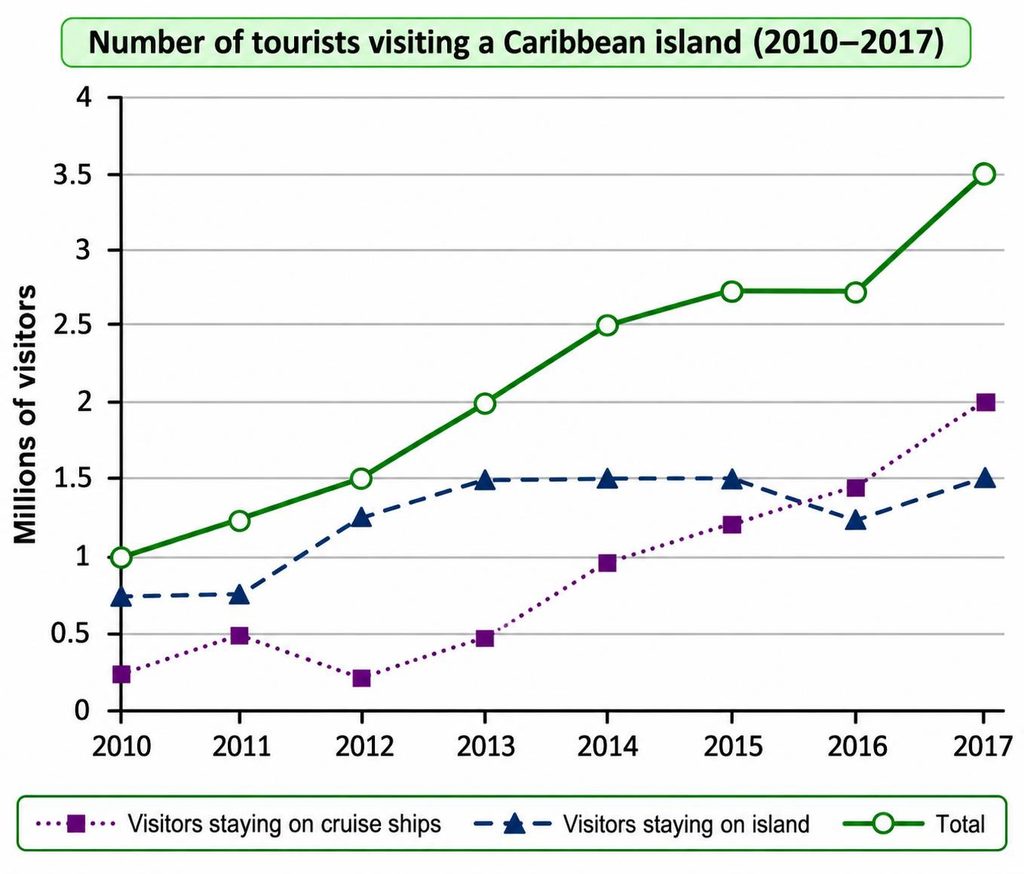
The graph below shows the number of tourists visiting a particular Caribbean island between 2010 and 2017.
Summarize the information by selecting and reporting the main features, and make comparisons where relevant.
Note: These IELTS Writing responses are subjective examples and do not guarantee the indicated band scores.
The graph shows the number of tourists visiting a particular Caribbean island between 2010 and 2017.
In 2010, total tourist is 1 million. Visitors staying on cruise ships is 0.25 million and visitors staying on island is 0.75 million. Then in 2011, total go up to 1.25 million. Cruise ships go up to 0.5 million, but island stay same at 0.75 million.
After that, in 2013, total is 2 million. Island is 1.5 million and cruise ship is 0.5 million. In 2015, total go up to 2.75 million. Island is still 1.5 million and cruise ship go up to 1.25 million.
Finally, in 2017, total is very big at 3.5 million. Cruise ship is 2 million and island is 1.5 million. All numbers go up from 2010 to 2017. However, tourists living on the island is stable.
(137 words)
The line graph shows how many tourists visited a Caribbean island between 2010 and 2017. It shows visitors staying on cruise ships, visitors staying on the island, and the total tourists.
Overall, total tourists increased a lot from 2010 to 2017. Cruise ship visitors increased more than island visitors during this time.
In 2010, total tourists was 1 million. Island visitors was 0.75 million and cruise ship visitors was 0.25 million. Then, total tourists went up every year until 2015, reaching 2.75 million, and stayed same in 2016. In 2017, total tourists reached 3.5 million.
For the two groups, island visitors increased to 1.5 million in 2013 and stayed at this level until 2015, before going down to 1.25 million in 2016. Cruise ship visitors went up from 0.25 million in 2010 to 1.5 million in 2016, and finally reached 2 million in 2017.
(144 words)
The line graph shows the number of tourists who visited a Caribbean island between 2010 and 2017, divided into visitors staying on cruise ships, visitors staying on the island, and the total number of visitors.
Overall, total tourist arrivals increased markedly over the period. Furthermore, while island-based tourists were initially more common, cruise ship passengers became the majority by the end.
In 2010, total visitors stood at 1 million, with 0.75 million staying on the island and 0.25 million on cruise ships. By 2013, island visitors had doubled to 1.5 million and remained unchanged until 2015. Over the same period, cruise ship tourists fluctuated slightly before rising to 1.25 million in 2015, bringing total visitors to 2.75 million.
In 2016, total numbers plateaued, though cruise ship visitors overtook island visitors at 1.5 million compared to 1.25 million. Finally, in 2017, overall arrivals peaked at 3.5 million, with 2 million on cruise ships and 1.5 million on the island.
(158 words)
The line graph illustrates the number of tourists visiting a particular Caribbean island between 2010 and 2017, categorized by accommodation type—cruise ships versus the island itself—alongside overall visitor totals.
Overall, total tourist arrivals experienced substantial growth over the eight-year period. Notably, while island-based visitors initially accounted for the majority of tourists, cruise ship passengers surged to surpass them by the end of the timeframe.
In 2010, total arrivals stood at 1 million, three-quarters of whom stayed on the island (0.75 million) compared to 0.25 million on cruise ships. Island-staying figures doubled by 2013 to 1.5 million and plateaued until 2015, before dipping slightly to 1.25 million in 2016 and recovering to 1.5 million in 2017.
Conversely, cruise ship numbers fluctuated mildly until 2012 (0.25 million), after which they climbed steeply, overtaking island visitors in 2016 (1.5 million) and reaching 2 million in 2017. Consequently, total arrivals rose steadily to 2.75 million in 2015, leveled off briefly, and peaked at 3.5 million in 2017.
(165 words)
The line graph tracks tourist arrivals to a Caribbean island between 2010 and 2017, distinguishing between visitors accommodated on cruise ships, those staying on the island, and the combined total.
Overall, total tourism more than tripled over the eight years, driven primarily by cruise sector expansion. While island-based tourists initially formed the majority, cruise passengers overtook them in the final two years to become the dominant group.
In 2010, overall arrivals stood at 1 million, with island visitors (0.75 million) outnumbering cruise passengers (0.25 million) three to one. Island-staying numbers doubled to 1.5 million by 2013 and held steady until 2015, before dipping to 1.25 million in 2016 and recovering to 1.5 million in 2017.
By contrast, following minor fluctuations through 2012 (0.25 million), cruise arrivals climbed sharply, surpassing island visitors in 2016 (1.5 million) and reaching 2 million by 2017. This surge propelled total arrivals from a 2015–2016 plateau of 2.75 million to 3.5 million.
(157 words)
IELTS Writing Task 2
In the future, nobody will buy printed books or newspapers because they will be able to read everything they want online without paying?
To what extent, do you agree or disagree with this statement?
Note: These IELTS Writing responses are subjective examples and do not guarantee the indicated band scores.
In the future, nobody will buy printed books or newspapers because they will be able to read everything they want online without paying. I completely agree with this idea.
Now a days, people use internet every day in all country. On mobile phone and computer, we can read news and book for free. Nobody want to pay money for newspaper because internet is very fast and easy. My father always read news on phone in the morning before go to work. Also, my friend read sport news in Facebook and YouTube. Paper newspaper is old style and waste many paper and tree.
Also, books are very expensive in shop today. Poor students cannot buy many book for study. Online platforms have many free PDF book and website for download. In the future, all school, college, and library will use computer and tablet only. Teacher will give homework in internet. People will not go to bookshop anymore because everything is in internet and easy find.
However, some old people like paper book because of eye pain when they look phone long time. They say paper book is good for eye and health. But old people is small number in world. Young generation like internet only and they never buy book.
In conclusion, printed book and newspaper will finish completely in the future because online reading is free and easy for everyone.
(230 words)
Many people think that in the future, nobody will buy printed books or newspapers because they will be able to read everything they want online without paying. I partly agree with this idea because both online reading and paper reading are useful.
First of all, reading on the internet is very common today in every country. People can read news and many books on their mobile phone and computer for free. Nobody wants to spend money for a newspaper every day when free news websites and social media give fast information. Also, students like online books because they do not need to pay money and they can read anywhere on their phone or tablet. So, paper newspapers and books are becoming less popular in the world today.
On the other hand, printed books and newspapers will not finish completely in the future. Many people still like holding a real paper book in their hand because looking at a phone screen for a long time causes eye pain and headache. For example, old people always like reading a paper newspaper in the morning with tea. Moreover, some important books for study and exams are not free on the internet, so students must go to bookshop to buy them.
In conclusion, although free online reading is very easy and popular today, printed books and newspapers will still stay in the future because some people prefer paper for their eyes and personal habit.
(240 words)
Many people believe that in the future, nobody will purchase printed books or newspapers because all reading materials will be available online for free. While I agree that online reading is becoming much more popular, I only partly agree that printed versions will completely disappear.
On the one hand, there are several reasons why digital reading is replacing paper books and newspapers. Firstly, the internet provides free and instant access to daily news and millions of e-books. People do not want to spend money on a newspaper when they can read the latest news on their smartphones for free at any time. Secondly, online platforms are much more convenient for students and workers because they can carry hundreds of books on one tablet or laptop instead of heavy bags every day.
On the other hand, printed books and newspapers will not disappear completely in the future. Many readers still prefer the physical feeling of holding a real paper book and turning the pages with their hands. Moreover, reading on digital screens for many hours can cause eye strain and headaches, which makes printed materials healthier for long reading sessions. In addition, not every book or academic journal is available online without payment, as authors and publishers need money to produce quality content for readers.
In conclusion, although free online content will greatly reduce the sales of printed newspapers and books, I believe some people will still buy paper copies for comfort, health, and specialized content.
(245 words)
It is often argued that in the future, nobody will purchase printed books or newspapers because all reading materials will be accessible online without cost. While I agree that digital platforms will significantly reduce the demand for physical publications, I disagree that printed versions will disappear completely.
On the one hand, there are strong reasons why online reading is becoming the primary choice for many people. Firstly, the internet provides free and instant access to breaking news and a wide range of digital books. Most consumers are unwilling to pay for a daily newspaper when they can read updated articles on their smartphones at no cost. Secondly, e-books offer great convenience, especially for students and commuters, as thousands of titles can be stored on a single lightweight device rather than carried in heavy bags.
On the other hand, printed books and newspapers will continue to have a market in the future. Many readers still prefer the physical experience of holding a paper book, turning its pages, and avoiding screen fatigue or eye strain during long reading sessions. Furthermore, not all written content can be provided for free online. Professional journalism, academic research, and bestselling literature require substantial funding, which means many publishers will continue to charge for both digital and printed editions.
In conclusion, although free online content will certainly cause a major decline in traditional publishing, I believe that printed books and newspapers will survive due to reader preference, health comfort, and the economic reality of producing quality writing.
(250 words)
The rapid proliferation of free digital content has led some observers to predict the total demise of paid print media, arguing that readers will eventually access everything they want online without cost. While traditional print sales will inevitably keep shrinking, such predictions conflate the fate of disposable daily news with that of enduring literature—and mistake current ad-supported web models for permanent economic reality.
Daily journalism has undeniably been upended by the internet. Because breaking news is an inherently perishable commodity, real-time web updates and social feeds have stripped print newspapers of their primary utility. With basic reporting largely monetized through digital advertising, most casual consumers understandably see little reason to pay for a physical paper that is already outdated upon arrival.
Books and long-form publications, conversely, resist both obsolescence and total demonetization. Producing rigorous scholarship, investigative reporting, or compelling original fiction demands sustained human labor that online ad revenue alone cannot finance; consequently, reputable publishers will continue monetizing serious writing through print editions and digital paywalls alike. Equally important, physical books fulfill deeper cognitive and cultural needs that glowing screens fail to satisfy. Reading on paper fosters sustained concentration free from hyperlinked distractions, while tangible volumes endure across generations as cherished personal artifacts, thoughtful gifts, and archival records.
Ultimately, although free online platforms have permanently displaced daily newspapers from mainstream habits, they will neither extinguish paid publishing nor render printed books obsolete. Economic sustainability and the irreplaceable sensory intimacy of print ensure that physical books will retain a loyal readership indefinitely.
(252 words)