
(All Boards | Common Question)
Subject Code: 107
Time: 3 Hours
Full Marks: 100
Part A – Reading Test
Marks: 60
1. Read the following passage and answer the questions no. A and B:
Behula is a legendary folk heroine and one of the main characters of Manasamangal; a medieval epic. She was the daughter of Sayven of Ujaninagar. Lakhindar was the youngest son of Chand Saudagar of Champaknagar. Behula grew up to be a beautiful and intelligent woman and was married to Lakhindar. Chand Saudagar, a devotee of Shiva, had boasted that he was cleverer and stronger than Manasa, the snake goddess. He built an iron chamber for Lakhindar, believing it to be impregnable. However, on the wedding night of Behula and Lakhindar, Manasa sent a snake to kill Lakhindar. The snake made itself as fine as a strand of hair and, entering the chamber through a minute hole, bit Lakhindar.
Behula refused to accept her husband’s death. She placed her husband’s corpse on a banana raft and set out on a hazardous journey towards the abode of the gods. Despite all the dangers and temptation she encountered, Behula continued her journey and finally succeeded in reaching the abode of the gods. She pleaded for her husband’s life and promised Manasa that Chand Saudagar would worship her. Moved by Behula’s love for her husband, Manasa not only restored Lakhindar but also his brothers whom she had killed earlier.
Behula returned home with her husband and brothers-in-law, and Chand Saudagar finally bowed before the might of Manasa. Lakhindar and Behula then returned to their heavenly abode as Aniruddha and Usa.
A. Choose the correct answer from the alternatives: 5 Marks
(a) What is Manasamangal?
(i) A medieval play
(ii) A medieval poem
(iii) A medieval epic
(iv) A medieval novel
(b) The word ‘legendary’ refers to—
(i) historical
(ii) infamous
(iii) mythical
(iv) renowned
(c) The synonym of ‘impregnable’ is—
(i) inaccessible
(ii) vulnerable
(iii) irresistible
(iv) nonproductive
(d) Why was the iron chamber built?
(i) To put the valuables inside
(ii) To save Lakhindar
(iii) To kill snakes
(iv) To imprison Manasa
(e) How did Behula float on water?
(i) On an iron raft
(ii) On a wooden boat
(iii) On a country boat
(iv) On a raft
Answers: (a) (iii) A medieval epic (b) (iii) Mythical (c) (i) Inaccessible (d) (ii) To save Lakhindar (e) (iv) On a raft
ব্যাখ্যা:
(a) Manasamangal মধ্যযুগের বাংলা সাহিত্যের একটি আখ্যানধর্মী কাব্য বা epic।
(b) Legendary অর্থ কিংবদন্তি-সম্পর্কিত বা লোককাহিনিতে প্রচলিত। প্রদত্ত বিকল্পগুলোর মধ্যে mythical সবচেয়ে উপযুক্ত।
(c) Impregnable অর্থ দুর্ভেদ্য বা যেটিতে প্রবেশ করা কিংবা আক্রমণ করা অসম্ভব। Inaccessible অর্থ দুর্গম বা প্রবেশ করা কঠিন।
(d) Chand Saudagar সাপের আক্রমণ থেকে Lakhindar-কে রক্ষা করার জন্য লোহার কক্ষটি তৈরি করেছিলেন।
(e) Passage অনুযায়ী, Behula তার স্বামীর মৃতদেহ একটি কলার ভেলায় রেখে যাত্রা শুরু করেছিলেন।
B. Answer the following questions: 2×5=10
(a) Do you think that Behula is a legendary character?
(b) How did Behula bring her husband’s life back?
(c) Why was Manasa angry with Chand Saudagar?
(d) What was the ultimate destination of Behula and Lakhindar? And how?
(e) Why did Manasa accept Behula’s prayer?
Answers:
(a) Yes, I think Behula is a legendary character. She was a beautiful, intelligent and courageous woman who undertook a dangerous journey to bring her dead husband back to life. Her extraordinary love, patience and determination made her a legendary heroine.
(b) Behula placed her husband’s corpse on a banana raft and began a hazardous journey towards the abode of the gods. After reaching there, she prayed to Manasa and promised that Chand Saudagar would worship her. Being moved by Behula’s love and devotion, Manasa restored Lakhindar’s life.
(c) Manasa was angry with Chand Saudagar because he refused to worship her. Instead, he worshipped Shiva and boasted that he was cleverer and stronger than Manasa, the snake goddess.
(d) The ultimate destination of Behula and Lakhindar was their heavenly abode. After Manasa restored Lakhindar’s life, they returned home. Later, they returned to heaven as Aniruddha and Usa.
(e) Manasa accepted Behula’s prayer because she was deeply moved by Behula’s extraordinary love and devotion to her husband. Moreover, Behula promised that Chand Saudagar would worship Manasa.
2. Read the text and make a flow chart showing the bad effects of overspending. (No. 1 has been done for you). 10 Marks
We spend money for different reasons. We buy foods, clothes or everyday essentials, pay for different services, entertain people, travel to places, help others in need or invest in business and thus spend money everyday. In fact, spending is a part of our life.
Spending may make us happy or unhappy depending on how and why we spend. When we spend money on things that we need and within our limit, it is good. When it becomes a compulsive behaviour, it makes life stressful. Unnecessary spending or spending beyond one’s means has some bad effects. For one thing, it may lead to financial ruin or debt, and for another, it may create unhappiness within families. People who overspend are never satisfied with what they have. They always rush for brands, fashion items, designer clothes, etc. Over a period of time it becomes an addiction which may eventually create psychological problems.
Flow Chart:
- Making life stressful → 2 → 3 → 4 → 5 → 6
Answer:
Making life stressful → 2. Leading to financial ruin or debt → 3. Creating unhappiness within families → 4. Causing dissatisfaction with what one has → 5. Developing an addiction → 6. Creating psychological problems
3. Write a summary of the following text: 10 Marks
For the first time the streets of Gaza were clean, there wasn’t a paper or cardboard. People were collecting the paper from the streets to use it for baking, because the electricity was disconnected. My mum did not want to bake and she asked me to bring bread from the oven. The queue at the oven stretched from Gaza to the West Bank. People would line up for hours to get to their turn and take half a pack of bread.
In seconds, a Palestinian rocket launcher was erected in the area and in less than one second the Israeli planes started bombing it. People began running in all directions and the ambulances came. People started falling dead …… others were injured. I was in shock, and people in the street started telling me: “Thank God, You’re safe.”
Anyway, I went back home without the loaf of bread. And my mum yelled at me but still today, she doesn’t know why I didn’t bring the bread.
Summary: The passage describes the narrator’s terrifying experience during an Israeli airstrike in Gaza. Due to electricity shortages, people collected paper and cardboard for baking. While searching for bread amid long queues, the narrator witnessed panic, deaths and injuries following an airstrike. Though he survived, he returned home without bread, and his mother scolded him unknowingly. (56 words)
4. Read the following text and fill in the blanks with suitable words from the boxes. There are more words than necessary. Make any grammatical changes if needed: 0.5×10=5
cultures | finally | cocoon | powerful | beauty | wings | symbols | associate | due to | connect | butterfly | regard
Butterflies are (a) — as powerful symbols in many (b) — and contexts. They are often (c) — with change and growth, (d) — their fascinating transformation from caterpillar to (e) — and finally into a graceful (f) —. In Greek mythology, psyche (meaning ‘Soul’) is often depicted with butterfly (g) —. Butterflies are thus (h) — to the soul and the quest for love and (i) —. In some cultures, particularly in Asia, butterflies appear in art as (j) — of love, romance, beauty and freedom.
Answers:
(a) regarded (b) cultures (c) associated (d) due to (e) cocoon (f) butterfly (g) wings (h) connected (i) beauty (j) symbols
ব্যাখ্যা:
(a) ‘Regarded as’ অর্থ হিসেবে বিবেচিত।
(b) ‘Many’-এর পরে plural noun cultures বসেছে।
(c) ‘Associated with’ অর্থ কোনো কিছুর সঙ্গে সম্পর্কিত।
(d) ‘Due to’ অর্থ কোনো কিছুর কারণে।
(e) Caterpillar থেকে পরবর্তী রূপ বোঝাতে cocoon ব্যবহৃত হয়েছে। তবে বৈজ্ঞানিকভাবে butterfly-এর জীবনচক্রে caterpillar-এর পরবর্তী পর্যায়কে pupa বা chrysalis বলা হয়।
(f) Caterpillar ও cocoon পর্যায় অতিক্রম করে পূর্ণাঙ্গ butterfly তৈরি হয়।
(g) Butterfly-এর ডানা বোঝাতে wings ব্যবহৃত হয়েছে।
(h) ‘Connected to’ অর্থ কোনো কিছুর সঙ্গে সংযুক্ত।
(i) Love and beauty একটি প্রচলিত শব্দযুগল।
(j) ‘Symbols of’ অর্থ কোনো কিছুর প্রতীক।
5. Fill in the gaps with appropriate words in each gap: 1×10=10
Air and water are two important (a) — of the environment. These elements are (b) — for life on earth. They are often (c) — in many ways. Air is polluted mostly by (d) —, water by different (e) — of waste. If we want to live a (f) — life, we should (g) — the pollution of the environment. Total prevention may be (h) — but we can certainly (i) — pollution by raising (j) — among people.
Answers: (a) elements (b) essential (c) polluted (d) smoke (e) kinds (f) healthy (g) prevent (h) impossible (i) reduce (j) awareness
ব্যাখ্যা:
(a) Elements অর্থ উপাদান; পরিবেশের গুরুত্বপূর্ণ উপাদান হলো বায়ু ও পানি।
(b) Essential অর্থ অপরিহার্য; পৃথিবীতে জীবনের জন্য বায়ু ও পানি অপরিহার্য।
(c) Polluted অর্থ দূষিত; বায়ু ও পানি বিভিন্নভাবে দূষিত হয়।
(d) Smoke অর্থ ধোঁয়া; ধোঁয়ার মাধ্যমে বায়ু দূষিত হয়।
(e) Kinds of অর্থ বিভিন্ন ধরনের।
(f) Healthy অর্থ সুস্থ; সুস্থ জীবনযাপনের জন্য দূষণমুক্ত পরিবেশ প্রয়োজন।
(g) Prevent অর্থ প্রতিরোধ করা।
(h) Impossible অর্থ অসম্ভব; সম্পূর্ণ দূষণ প্রতিরোধ করা কঠিন।
(i) Reduce অর্থ কমানো; দূষণের মাত্রা কমানো সম্ভব।
(j) Awareness অর্থ সচেতনতা; জনসচেতনতা বৃদ্ধির মাধ্যমে দূষণ কমানো যায়।
6. The following sentences are jumbled. Rearrange them in proper sequence: 1×10=10
(a) The grapes were too high for him to reach.
(b) One day, he was very hungry.
(c) Again and again, he jumped.
(d) At last, he entered a vineyard.
(e) Once upon a time, there lived a fox in a forest.
(f) At last, being tired, he went away saying that the grapes were sour.
(g) But each time he failed to reach the grapes.
(h) He took a run and jumped to reach the bunch of grapes but could not reach it.
(i) He searched for food everywhere but he did not get any food.
(j) There were ripe grapes hanging up on the vine.
Answers: (e) → (b) → (i) → (d) → (j) → (a) → (h) → (c) → (g) → (f)
The Fox and the Grapes
Once upon a time, there lived a fox in a forest. One day, he was very hungry. He searched for food everywhere but he did not get any food. At last, he entered a vineyard. There were ripe grapes hanging up on the vine. The grapes were too high for him to reach. He took a run and jumped to reach the bunch of grapes but could not reach it. Again and again, he jumped. But each time he failed to reach the grapes. At last, being tired, he went away saying that the grapes were sour.
Part B – Guided Writing
Marks: 40
7. Write a paragraph on ‘Artificial Intelligence’, answering the following questions in about 200 words. 10 Marks
(a) What does artificial intelligence (AI) refer to?
(b) Name some areas where AI is widely used today.
(c) What are the benefits of using AI for teachers in the classroom?
(d) Why is it important for students to learn about AI?
(e) What are the challenges of using AI tools?
Artificial Intelligence
Artificial Intelligence (AI) refers to the ability of machines and computer systems to perform tasks that normally require human intelligence, such as learning, problem-solving and decision-making. Nowadays, AI is widely used in education, healthcare, agriculture, banking, transportation and communication. In education, AI helps teachers prepare lesson plans, create learning materials, evaluate students’ performance and identify their individual learning needs. It also saves teachers’ valuable time by assisting them with routine tasks. Students should learn about AI because it is becoming an essential part of modern education and the future job market. It helps them develop digital skills, creativity and problem-solving abilities. However, excessive dependence on AI may weaken critical thinking. Inaccurate information, privacy risks and misuse are also serious concerns. Therefore, AI should be used responsibly. It cannot replace human intelligence or teachers’ guidance; rather, it should support learning and improve the quality of education. (147 words)
8. The following is the beginning of a story. Complete it in your own words. Give a suitable title to it: 7 Marks
Shakil, a university graduate from the department of Food and Nutrition, returned to his village due to his failure to get a suitable job. Being frustrated, one day sitting under a tree he noticed the fall of date juice drop by drop into the jar. Suddenly a new idea came to his mind and thought of processing date juice ……………………………………………..
A New Beginning
Shakil, a university graduate from the department of Food and Nutrition, returned to his village due to his failure to get a suitable job. Being frustrated, one day sitting under a tree he noticed the fall of date juice drop by drop into the jar. Suddenly a new idea came to his mind and thought of processing date juice. He decided to produce quality date molasses. He shared his idea with his family and started collecting date juice from local farmers. Initially, he faced financial difficulties, but he did not give up. Gradually, his products became popular in nearby markets. He also started selling them online. Soon, his business became successful, and he employed several unemployed young people from his village. Shakil realized that creativity and hard work could turn a problem into an opportunity. His success inspired others to become self-reliant. (145 words, total)
9. Suppose, you are Rakib/Rakiba. Your friend Tomal/Tomalika got the first prize on the National Debate Competition-2025. Now write an email congratulating him/her. 5 Marks
To: tomal@example.com
Subject: Congratulations on Your Brilliant Success
Dear Tomal,
I am delighted to hear that you have won first prize in the National Debate Competition-2025. Congratulations on your outstanding achievement!
Your success reflects your hard work, confidence and excellent debating skills. I always knew you were talented, and you have once again proved your ability. You truly deserve this recognition.
Keep up the good work. No more today. Convey my regards to your parents.
Yours ever,
Rakib
(78 words)
10. The pie chart below shows the percentage of supporters of different games in Bangladesh. Now, describe the chart in about 150 words. You should highlight and analyze the information given in the chart. 10 Marks
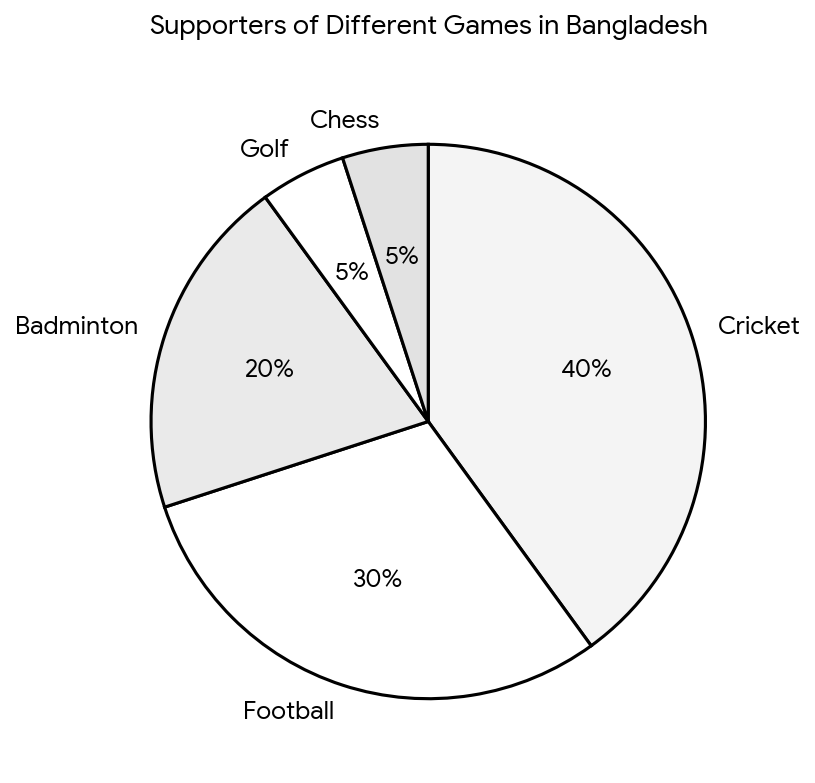
Popularity of Different Games in Bangladesh
The pie chart illustrates the percentage of supporters of five different games in Bangladesh. It shows that cricket is the most popular game, attracting 40% of the supporters. Football holds the second position with 30% of the total supporters. Together, cricket and football account for 70% of the supporters, indicating their overwhelming popularity among the people. Badminton ranks third, with 20% of the supporters. On the other hand, chess and golf are equally popular among the remaining supporters, each accounting for only 5%. The chart clearly indicates that cricket and football dominate people’s preferences in Bangladesh. Badminton also enjoys considerable popularity, whereas chess and golf have relatively fewer supporters. Overall, cricket leads the chart by a significant margin, while chess and golf share the lowest position. The figures suggest that people’s interest in games is not equally distributed, with cricket being the clear favourite. (150 words)
11. Write down the theme of the following poem. 8 Marks
Say unto brethren when they see me dead,
And weep for me, lamenting me in sadness:
Think ye I am this corpse ye are to bury?
I swear by God, this dead one is not I.
I in the spirit am, and this my body
My dwelling was my garment for a time.
I am a treasure: hidden I was beneath
This talisman of dust, wherein I suffered.
I am a pearl; a shell imprisoned me,
But leaving it, all trials I have left.
I am a bird, and this was once my cage;
But I have flown, leaving it as a token.
Theme:
The poem explores the immortality of the soul and the meaning of death. The speaker considers the body a temporary dwelling, while the soul is eternal. Through images of a garment, shell and cage, the poet portrays death as the soul’s liberation from physical limitations and the beginning of a spiritual journey. (53 words)